
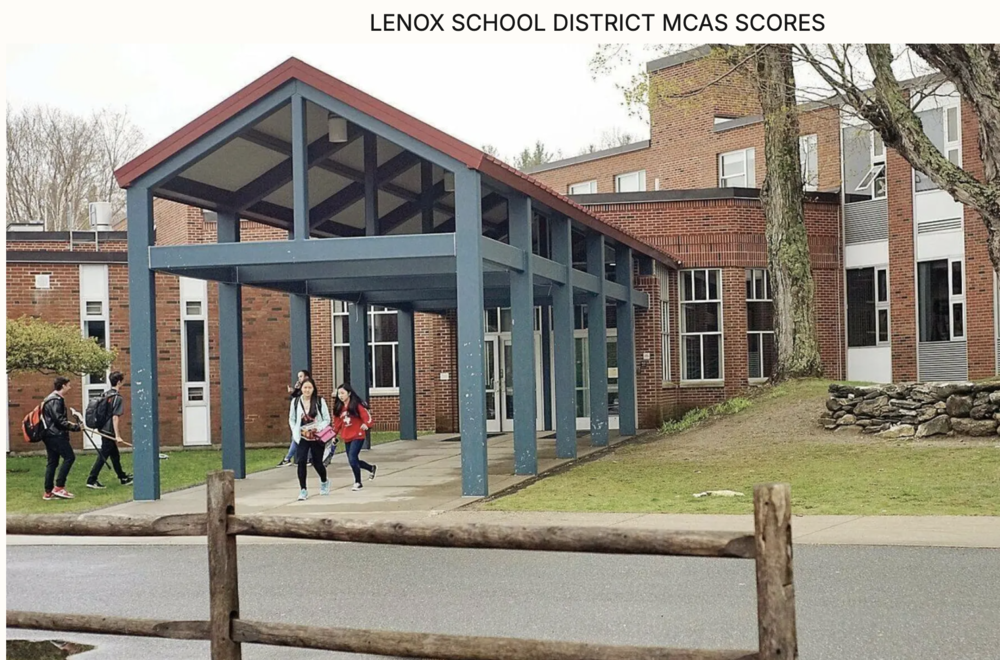
Clarence Fanto - Berkshire Eagle. Grade 10 students had the third-best score statewide for English Language Arts.
LENOX — Lenox public school students met or exceeded expectations on the 2025-26 MCAS exams at rates above the state average in every grade and subject tested.
Across grades three to eight at Morris Elementary School and Lenox Memorial Middle and High School, students typically outperformed statewide averages by more than 20 percentage points in several grades and subjects, with the largest margin reaching 29 percentage points in eighth-grade math, Superintendent William Collins said.
Grade 10 students posted particularly strong results, Collins noted. In English language arts, 89 percent met or exceeded expectations, compared with 45 percent statewide. LMMHS students tied for the third-highest rate in the state for that grade and subject.
"These results speak to the work our students and educators put in every day," said Collins. "We will use these results to build on their progress and continue to identify areas where they may need more support."
The Massachusetts Department of Elementary and Secondary Education released the results on Sept. 22.
At Monday night’s School Committee meeting, televised and available on ctsbtv.org Channel 1302, LMMHS English teacher Robin Getzen acknowledged that students have raised questions about the new cellphone policy requiring devices to be locked up throughout the school day.
“The changes created by the Yondr pouches is nothing short of remarkable,” she said. “Before the new policy, phones were a distraction to plan meet-ups during class time" and other activities.
Getzen said the policy has encouraged more face-to-face communication among students, leading to greater participation in classroom discussions. “It is a change you can feel when you walk into a class, the library and the cafeteria,” she said.
She also pointed to a greater sense of order and calm during the busy periods at the beginning and end of the school day.
“Students will complain, yes, that’s written into their job description,” Getzen acknowledged. “But they know where the line is and they know it will be held; that’s how we keep them safe. We are seeing a school day that gives our kids more to learn and connect, and make the most of their time with us.”
School Committee Chair Michael Dupont read a letter from Lisa Wespiser, an English teacher who has taught at LMMHS for 16 years, praising newly appointed Principal Brooke Kamienski for her “confident, clear-stated goals designed for the good of teaching and learning."
“The Yondr pouches and the bell-to-bell phone policy are bringing a vibrancy to the hallways and classrooms that we have long missed,” Wespiser said.
Wespiser also commended Kamienski for “thoughtful and comprehensive communication on this and other policies [that have] shepherded us through seamlessly from what otherwise could feel like burdensome changes.”
Among her school improvement goals for the current school year, Kamienski called for providing “meaningful feedback” to all staff members on their instructional work, establishing shared expectations and building trust and transparency to foster a positive school culture.
She cited the bell-to-bell electronics policy as “so important to establishing a positive school culture. When students were on their phones, it caused distraction to the learning environment but it also caused a lot of conflict problems and a lot of bullying.”
Kamienski said the policy also limits opportunities for students to communicate or interact in ways that might escape school leaders' notice.
“It reduces the opportunities kids have to send a text that’s really mean to someone, or share a rumor,” she noted.
Acknowledging that students didn’t welcome the phone-free policy, “they’re now accepting and honoring that policy and doing very well with it,” said Kamienski.
Collins also reported that school choice students account for just under 42 percent of district enrollment. Total enrollment stood at 742 students as of Oct. 1, down from 771 a year earlier.